Elementary Lesson Plan
2nd Grade
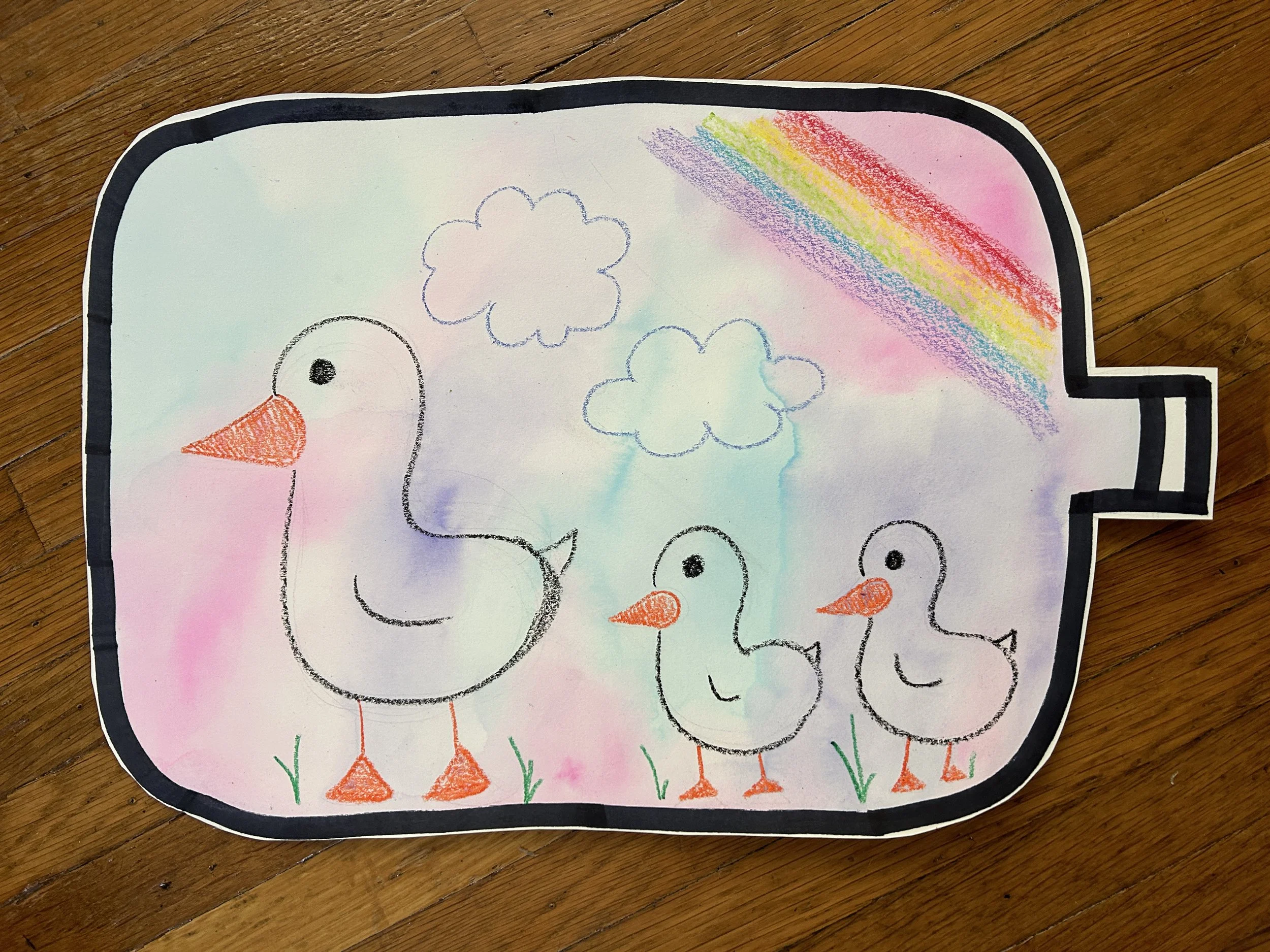
Memory Jars
Teacher Exemplar
UNIT OVERVIEW
These lessons will have a focus on identity. Students will be able to reflect on what they experience and what they value as they grow up. This is important for students to learn about because it can help them develop a true sense of individuality while also exploring what they have in common with others.
LESSON OVERVIEW
In this lesson we will be making memory jars inspired by In a Jar by Deborah Marcero. Students will be asked to ‘fill up’ a 2D jar with a memory. The memories we keep are important to us. This will help students reflect on meaningful moments they’ve had. Students will create a deeper sense of individuality and be able to build their connections with others by sharing this memory.
Students will learn about space as an element of art. Students will learn positive and negative spaces to be able to analyze works and improve their own.
ESSENTIAL QUESTIONS
What memories do we want to carry along with us and share?
How can we show what is the most important thing in our favorite memory?
LEARNER OBJECTIVES/OUTCOMES
Further develop fine motor-skills.
Utilize the sketch process to build confidence.
Explain positive and negative space in relation to their work.
Explore a memory that is meaningful to them.
NATIONAL ART STANDARDS
VA:Re7.1.1a - Select and describe works of art that illustrate daily life experiences of one’s self and others.
VA:Cr3.1.1a - Use art vocabulary to describe choices while creating art.
VA:Cn10.1.1 - Create works of art about events in home, school or community life.
INTERDISCIPLINARY CONNECTIONS:
This lesson will be connected to language arts. Prior to the lesson, we will read In a Jar by Deborah Marcero. This book shows two characters putting their memories in a jar to keep. This will help develop the idea of the lesson and make sure students have an understanding of a personal memory.
ART OF RELEVANCE FOR LESSON:
Joanne Thomson
Thomson did a mason jar series that captured the memory of her grandmother and grandfather. She uses watercolor and some of the jars include things that we normally wouldn’t see in a jar, like these recorders below.
Charles Burchfield - The Big Tree
Showing students examples of watercolor artwork.
Yinka Shonibare - Nelson’s Ship in a Bottle
A 3D example that shows something in a bottle that isn’t normally found in a bottle. It still takes up most of the space inside the bottle.
VOCABULARY AND DEFINITIONS:
Positive Space - Space that has a subject or object or that is interesting.
Negative Space - The background space or empty space.
Memories - An experience or something that you remember.
Wax resist - A way to paint over our drawings with crayon. The water does not like the wax of the crayon.
ENDING THE LESSON
Closure of Lesson:
I will make sure students understand positive and negative space by their composition - how they fill up their memory jar. Drawn objects should take up a big amount of space. Drawn objects should not be tiny. Students should be able to point out they used positive space. Students will have a 2D memory jar as their final artwork.
Transition to Next Lesson:
Sketching and planning drawings is a skill that students can use for future projects and will be used throughout my various lessons to encourage artistic confidence.
Positive and negative space will be used in discussing other art works and used in creating future pieces.
Assessment:
Students have met the learning objectives and will be assessed on if they can point out positive and negative space in artworks and discuss why we decided to use positive space in our memory jars. I will know if they understand this by how they fill the big sheet of paper that is their memory jar. If a student only makes very small drawings, they have not grasped the concept of positive and negative space as the expectation for this artwork is that they fill up the jar.